Wednesday, July 16, 2008

Smart in the Office/Smart in the Truck – Doing more to perfect data collection and positively impact performance through in cab technology

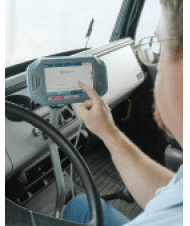
While a few system providers have offered onboard fleet management tools for several years that include computing power, memory, touchscreens, and even a database in the cab of the truck, there has certainly been an uptick recently of more vendors joining that club. Clearly the industry sees benefit in doing more on board. There is no shortage of good reasons for this.

Customers have discussed with me an array of results they will achieve by leveraging technology in the cab, and even beyond the cab with handheld devices, sensors, etc. Eliminating paperwork not only makes life easier for the driver and for administrative personnel…it also drives accuracy. Reduced errors mean better customer service and a direct path to better results at the bottom line.

Efficiency increases by accurately capturing and communicating in a timely and actionable way the events that occur in the field. One industry veteran told me that, “the best data is data captured as close as possible to the point at which it happens.” With the right onboard tool, the quantity and quality of actionable data improves. No averages…no gaps. The beauty of the newer technology on board is not only the capture of this information, often in an automated or minimal keystroke way, but also the ability to manage the communication of that data so that it gets to the right place at the right time….IN A WAY THAT MAKES FINANCIAL SENSE.

Sorry to yell there, but it is an important point. Recognizing the value of doing more on board is one thing. Pulling it off in a cost effective manner is something else. This is where the focus comes off of the onboard device, and on to the applications and overall system architecture. Without this part being right, the value of the onboard device cannot be optimized.

A powerful onboard computer whose cost to use is unaffordable does not get the desired result. Think about the possibilities…..handheld POD….temperature, tire pressure, weight, rollover sensor and other monitoring…..cameras….fatigue detection….onboard navigation…driver entertainment and training! The capabilities and their potential impact are remarkable. Happier, retained, safer drivers…attracted from the younger pool of people in the workplace is an example. This technology migration is a meaningful, positive trend for the industry which, when done right, creates a big win for everyone in the supply chain, as a friend in the food distribution industry puts it….from “farm-to-fork.”

Tuesday, July 15, 2008

Driver Scorecards Help Manage Employees

In a recent “Trucks at Work” blog posting, Sean Kilcarr discussed Dealing with the Bad – highlighting different methods and techniques for dealing with bad employees. See his post here.

Another method for dealing with bad drivers in the trucking industry that is growing more common is driver score cards. Many private fleets have adopted this practice to help their safety initiatives, fuel conservation, incentive-based pay and driver retention. Scorecards are a very powerful means of behavior modification. There are some businesses that post their driver scorecards every week in their driver's break room for all to see. The exposure gives credit to the strong drivers, and puts pressure on those that need improvement (peer pressure and management pressure). Driver scorecards and KPI (key performance indicator) dashboards are available as stand-alone products, as part of consulting services and in some fleet management solutions.

Information on Cadec’s GYR Driver Scorecard can be found at http://www.cadec.com/solutions/fleetSafety.php#anchorOne

You can also check out how some companies are using the Cadec Driver Scorecard in the Resource section at www.cadec.com.

Author: Frank Moreno

Thursday, July 10, 2008

The “Perfect” Foodservice Delivery

Is there such a thing as the “Perfect” delivery in the food service industry? There are so many variables that impact delivery costs. Let’s review some of these common issues and what they tend to result in:

Routing – out of route miles not only have a have dramatic impact on fuel consumption, the resulting delays can have a negative impact on customer service with late arrivals and missed delivery windows. Additionally, when drivers select or are assigned routes that will exceed their available hours of service, the company is at risk of facing non-compliant fees.

Paperwork errors – if you’re in the delivery industry, the amount of paperwork you process is unfortunately very familiar. Manifests, driver logs, inspection reports, invoices, delivery routes, credits/returns, physical assets (pallets, bins, crates, etc.) are manually processed on a daily basis.

Shrinkage – no, this is not a reference to a great 80’s sitcom. What this refers to is lost profit based on not getting paid for things allocated in your operating plan. In addition to spoilage, and OSD (overs, shorts and damages) a common contributor to shrinkage is theft – disappearing inventory from the delivery truck. It’s always funny when the items that are reported “missing” from the drivers are the cases of T-bone steaks, and never the broccoli.

These are just a sample of the types of issues that plague foodservice delivery. The question is, are these problems accepted and commonly written off? Or, is there an alternative with best practices and technology to help improve customer service, reduce costs and increase business productivity? Is the perfect delivery attainable?

Well, today’s new technology addresses many of the challenges facing the delivery process. The combination of fleet management, wireless communications, on-board/in cab computing and handheld computers/scanners with mobile delivery applications provide new levels of visibility and automation beyond the warehouse, into the delivery vehicle and onto the loading docks of customers.

Routing systems can track each driver and their available hours, and assign routes that fit within their availability based on known drive times. On-board computing systems can not only provide GPS tracking for real-time route validation, many systems can alert when drivers go out of route, track & calculate out of route miles, identify unknown stops and measure the time between stops. Additionally these systems can provide instant messaging to drivers, verify delivery locations and run in-cab, turn-by-turn navigation applications. There is now more visibility than ever before into routing and driver performance to optimize delivery routes, and with web-based applications and standard interfaces such as XML and web services, these once-disparate systems can now integrate seamlessly to automate many processes, improve customer service and reduce fuel consumption.

In many companies, deliveries create unless amounts of paperwork. Forms and documents constantly require manual, human data input, which businesses base their entire operations on. These labor-intensive administrative processes are subject to error in nearly every step they touch – particularly in item counts. Inaccurate counts can impact inventory, customer service, forecasts and ultimately profits. Unfortunately, paper-based processes are often “counted” or have data inputs multiple times, further increasing the chance for errors. The adoption and integration of handheld computers, bar code scanners, mobile delivery applications and soon RFID alleviates many of these error-laden processes, and automates data capture.

Controlling inventory and asset loss is a critical step towards increasing profits in delivery operations. Electronic manifests combined with scanned inventories for each delivery provide an accurate count of every item on a specific truck and details on where those items need to go. With mobile delivery applications, every item on a vehicle must be accounted for at all times. This helps to avoid incorrect items at a site, incorrect item quantities at a site, items delivered to the wrong site, items that don’t belong on a truck, items that are manually picked at the delivery site and items that are missing from the truck. By having every item electronically scanned and accounted for, the opportunity and potential for theft is reduced if not eliminated and the cost of shrinkage is avoided.

While the Perfect Delivery may still be a challenge, it is more attainable than ever before. The implementation of these integrated systems and efficiencies may not yield errorless delivery operations, the impact on productivity and cost savings is clearly compelling enough for any private fleet, LTL or TL for-hire fleet.

Please comment on your thoughts on whether the "Perfect Delivery" is possible and why.

Author: Frank Moreno

Wednesday, June 4, 2008

ITLC Conference Highlights Trends and Issues in Technology for the Trucking Industry

I spent the past two days attending the Information Technology Logistics Council (ITLC) Conference in Chicago. This three day event boasted a very strong agenda and was all attended by fleets, vendors and industry/government officials. Here are a few observations from the event:

EOBRs in the Industry – It was AMAZING to see just how many fleets are not using ANY type of onboard computers/recorders in their vehicles. While most of the attendees seemed to be in the For Hire (truckload and LTL) market segments, it is still mind boggling to me that the efficiencies gained by EOBRs are not more embraced by these fleets. This session highlighted the upcoming ruling by the FMCSA on probable EOBR mandates and what that will mean for the industry. It was clear that most fleets were investigating this technology and are anticipating some type of requirement for onboard recorders. It was also clear that while the ruling will only focus on HOS information, there is significant value in today’s systems far beyond electronic logs. Telematics data, driver performance, fuel conservation and turn by turn navigation are just a few of the benefits of today’s more advanced systems.

Eye Opener – the reliance on EDI amongst these companies was astounding. Having spent time with software vendors aimed at the financial services industry, the use of XML-based web services has been prevalent for five if not ten years. It was extremely disappointing to hear the “Web Applications in the Supply Chain” session highlight the importance of integrations using EDI. In 2008, any transportation company executive considering an IT investment in web applications fir their fleet management, transportation management system or any supply chain component would be essentially throwing money away if their systems were not leveraging web services and SOA integration. Today’s leading supply chain and transportation systems from vendors like TMW Systems, ALK, Manhattan Associates and many others are leveraging service oriented architecture and web services to facilite standards-based web application integration. Why? This ensures that the integrations are sustainable (not impacted by change) and are flexible enough to integrate with any system.

This is just a sample of articles that review the evolution of EDI with XML and SOA:
http://www.ebizq.net/topics/soa/features/8206.html
http://blogs.zdnet.com/service-oriented/?p=208
http://soa.sys-con.com/read/563225.htm

Exciting topic – Wireless Roadside Inspection (WRI). This was very cool. While it is still in pilot phase, the idea of a vehicle driving by an inspection station and instantly uploading HOS data to an inspector’s laptop, without stopping was very exciting. Keep your eyes open for more details on this.

Overall this was a very good conference and should be closely watched and considered next year. It would be very interesting to see more private fleets represented next year to highlight how their technology adoption is more mature than those for hire fleets. The advancements in supply chain optimization and technology adoption is far more prevalent in the private fleet sector and would be a valuable addition to next year’s event.

Author: Frank Moreno

Tuesday, June 3, 2008

Private Fleets Fighting Back – Saving Thousands with Fleet Management

Northwest Food Products Transportation increases fuel economy, saves $500,000 in fuel in first year with Cadec. “One of the greatest cost savings achieved from our Cadec investment has been in the area of fuel economy. With our Cadec software, we were able to monitor their use of progressive shifting, a driving technique that can help save fuel by ensuring that trucks are running at lower RPMs. Increasing fuel efficiency by just one-tenth of a mile saves NFPT $100,000 annually. Through monitoring with Cadec, we were able to increase MPGs by a half-mile per gallon, saving $500,000 in fuel in the first year alone. That savings alone more than paid for our investment in Cadec. Maintenance costs also went down by 4.5 cents a mile. By reducing sudden decels and increasing use of progressive shifting, we had far fewer brake jobs on our hands.” Roger Nordtvedt, General Manager; Northwest Food Products Transportation

Automation helps CN Brown ensure timely delivery, improve safety and reduce operating costs in their fuel transportation business. “Cadec enables us to monitor and reduce idle time.That directly impacts the amount of fuel our fleet uses. Even with increases in fuel and operations costs and an additional 90,000 miles on the road in 2007, C.N. Brown was able to cut its overall fleet cost by three cents per mile as compared to 2006 – resulting in a total savings of $57,000. “Cadec’s software played a significant role in that,” Ken Cannell, Transportation Manager; CN Brown

G&C Foods Takes Control of Rising Transportation Costs, anticipating $300,000 savings in first year. “Within one week, we saw drastic reductions in both speeding and excessive idling. Our reports went from 80 percent red to just a few drivers in the red, and over time we’ve seen more improvements. Our ability to track this behavior with Cadec had a major impact on driver behavior... Penalties for Hours of Service violations are dramatic, and no matter how meticulous you think you are, paper logs are subject to basic human error. Cadec automates the whole process for us, recording hours of service, pickups, dropoffs… everything that we used to record by hand. Drivers don’t even need to think about it. Cadec ensures our records are accurate and complete.” Larry Clark, Transportation Manager; G&C Foods

“Our overall transportation expenses for 2008 will be about $6 million. If Cadec helps reduce that by just three percent, that’s $180,000 in savings. But when we consider all the areas Cadec can contribute to – reduced fuel consumption, safety improvements, better logging compliance, better return tracking, and improving our ability to collect on invoices – we think our savings will be closer to $300,000 per year. Cadec will be the key to reducing our transportation costs while improving service to our customers.” David LePage, President; G&C Foods

Morning Star anticipates cutting repair and maintenance costs in half “Most years we spend about $1.5 million on repair and maintenance, including accidents. A rollover, for instance, costs about $80,000, and even a minor incident can cost $10,000. We think that monitoring for safety through Cadec, and associated remedial training, can help us cut that $1.5 million in half.” Paul Pimmetel; Morning Star Foods

To read the complete case studies on each of these companies visit http://www.cadec.com/resources.php

Author: Frank Moreno

Wednesday, May 21, 2008

The 100% Wireless Coverage Fantasy for Fleet Management

Going back a few years to when the earth was still cooling, dinosaurs ruled, and I first entered the wireless industry working for Motorola, we were taught a mantra for setting customer's coverage expectations...."90% of the places, 90% of the time." Even with the advent of GEO and now LEO satellite communications, it may be reasonable to bump up the percentage a bit....but the mantra holds true. There are just too many variables, even with combined satellite and terrestrial communications, to make the 100% claim. Buildings, trees, valleys and other physical blockages, atmospheric conditions, sunspots, and more all factor in.

I still hear that 100% expectation in the course of doing business though - now in the fleet management space. No question it is a noble goal, but that's all. In my opinion, any vendor that promises, implies or suggests to a customer the possibility of 100% wireless coverage should be met with high scrutiny regarding any of the other "commitments" they may be making.

Author: Steve Katz

Tuesday, May 20, 2008

More Truck Crashes Highlight Importance of EOBR/OBCs and FMCSA’s upcoming Ruling

Yesterday’s accident in Illinois was another example of the critical role that electronic on-board recorders (EOBR) and on-board computers (OBC) have in the transportation business and a fleet management strategy. A trailer hauling 14 tons of Oreo cookies overturned on I-80 at around 4am, 50 miles southwest of Chicago.

The driver allegedly fell asleep at the wheel and slammed into the median. The trailer was owned by a leading, national for-hire trucking company.

While it is not known whether the vehicle was using any type of on-board system, any time a driver falls asleep at the wheel, hours of service (HOS) compliance comes into question. To address this issue the FMCSA will release a final EOBR rule this fall, potentially involving incentives and/or mandates for the use of EOBRs .

Not only would HOS violations be identified and potentially avoided, excessive speed audible warnings could also aid in helping prevent some accidents.

Author: Frank Moreno